5

Determine all integer solutions to the equation $x^2 + xy − 3y^2 = 17$.

The previous part of the question was finding the fundamental unit in $\mathbb{Q}(\sqrt{13})$, which is $\varepsilon = \frac{3+\sqrt{13}}{2}$, so my guess is that I should factorise the equation in $\mathbb{Q}(\sqrt{13})$ and then use the uniqueness of factorisation of ideals into prime ideals. (But it is also possible that the parts of the question are unrelated, because they certainly seem unrelated.)

J. W. Tanner
  • 60,406
mathmo
  • 1,192
  • How do you know if there are any integer solutions to begin with? (Of course there is, ex (11,8) but this should be your first strategy) – imranfat Aug 26 '20 at 15:56
  • Yes, I also found $(x, y)=(\pm 4, \pm 1)$, but I expect infinitely many solutions anyway. – mathmo Aug 26 '20 at 16:02
  • 5
    $(2x+y)^2-13y^2=68$ is a Pell-type equation – J. W. Tanner Aug 26 '20 at 16:03
  • Thank you, I can solve that now! – mathmo Aug 26 '20 at 16:06
  • 2
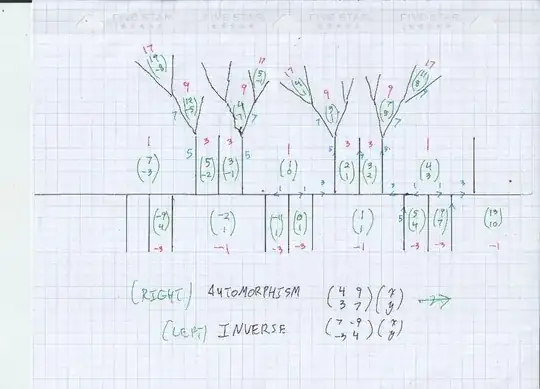
    With prime target, there are two orbits under the form automorphism and its inverse, $$ (x,y) \mapsto (4x+9y, 3x+7y). $$ There is also a single map (involution) of determinant $-1$ here, $(x,y) \mapsto (x+y, -y).$ – Will Jagy Aug 26 '20 at 16:34

3 Answers3

7

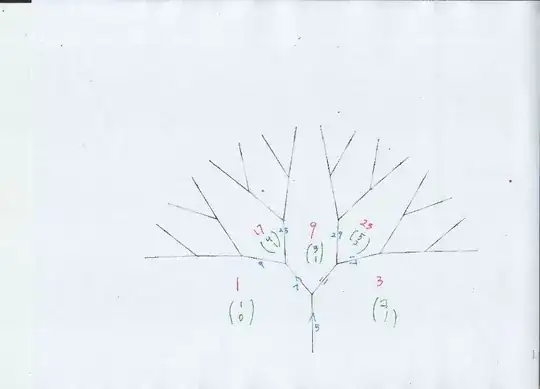
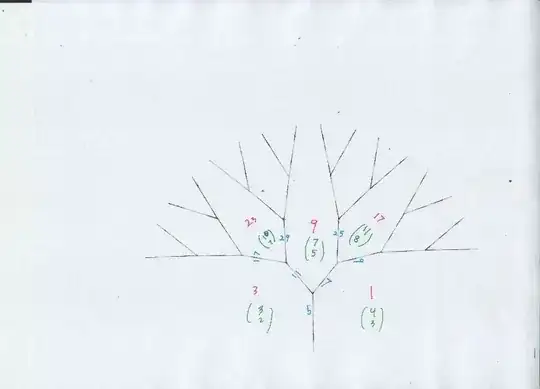
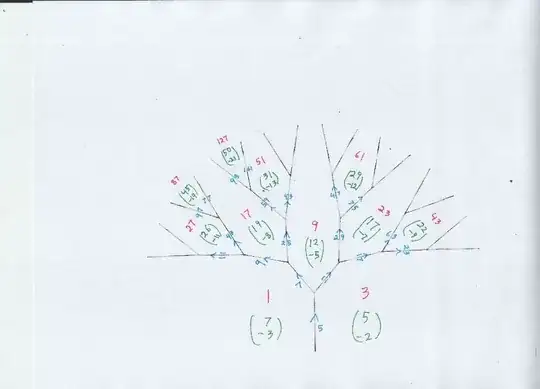
Conway's Topograph, with some artwork improvements of mine. I found that I really wanted to draw the "river" as a straight line. When there is not really enough room to draw in the representations of a number (17) I realized that drawing a separate (rooted) tree as though growing from the river allowed for a more legible rendition of that number representation. For that matter, while correctly drawing the river alternates among Conway's rules, once one of these trees is correctly begun, it is just one small collection of rules to expand it outward. Now that I think of it, there are intricate rules about the direction of the little blue arrows along the river, but in a tree they all go the same way, away from the tree root when the pink values in the tree are positive. The really big item was simply that the generator of the automorphism group, which is a 2 by 2 matrix, appears as explicit columns (in green) in the diagram. Let's see, I don't know any book that consistently draws in all of Conway's numbers, all of which have meaning; I started using four colors once I saw the legibility problems.

Oh, forgot this part. From the automorphism matrix, Cayley-Hamilton says that we get two $x$ orbits and two $y$ orbits, trace is $11$ so each is $$ x_{n+2 } = 11 x_{n+1} - x_n $$ $$ y_{n+2 } = 11 y_{n+1} - y_n $$ One orbit of pairs is $$ 19,4,25,271,...$$ $$ -8,1,19,208...$$ The other orbit of pairs $$ 5, 11, 116, 1265, ... $$ $$ -1,8, 89, 971, ... $$

Since there is a mixed $xy$ term in this one, the orbits should be extended backwards as well as forwards. One way to write that is

$$ x_n = 11 x_{n+1} - x_{n+2} $$ $$ y_n = 11 y_{n+1} - y_{n+2} $$
enter image description here enter image description here enter image description here enter image description here enter image description here

Generate solutions of Quadratic Diophantine Equation diagrams

Another quadratic Diophantine equation: How do I proceed?

How to find solutions of $x^2-3y^2=-2$?

Generate solutions of Quadratic Diophantine Equation

Why can't the Alpertron solve this Pell-like equation?

Finding all solutions of the Pell-type equation $x^2-5y^2 = -4$

If $(m,n)\in\mathbb Z_+^2$ satisfies $3m^2+m = 4n^2+n$ then $(m-n)$ is a perfect square.

how to solve binary form $ax^2+bxy+cy^2=m$, for integer and rational $ (x,y)$ :::: 69 55

Find all integer solutions for the equation $|5x^2 - y^2| = 4$

Positive integer $n$ such that $2n+1$ , $3n+1$ are both perfect squares

Maps of primitive vectors and Conway's river, has anyone built this in SAGE?

Infinitely many systems of $23$ consecutive integers

Solve the following equation for x and y: <1,-1,-1>

Finding integers of the form $3x^2 + xy - 5y^2$ where $x$ and $y$ are integers, using diagram via arithmetic progression

Small integral representation as $x^2-2y^2$ in Pell's equation

Solving the equation $ x^2-7y^2=-3 $ over integers

Solutions to Diophantine Equations

How to prove that the roots of this equation are integers?

Does the Pell-like equation $X^2-dY^2=k$ have a simple recursion like $X^2-dY^2=1$?

http://math.stackexchange.com/questions/1737385/if-d1-is-a-squarefree-integer-show-that-x2-dy2-c-gives-some-bounds-i/1737824#1737824 "seeds"

Find all natural numbers $n$ such that $21n^2-20$ is a perfect square.

Is there a simple proof that if $(b-a)(b+a) = ab - 1$, then $a, b$ must be Fibonacci numbers? 1,1,-1; 1,11

To find all integral solutions of $3x^2 - 4y^2 = 11$

How do we solve pell-like equations?

Will Jagy
  • 139,541
  • I'll do the first upvote.:) Did you draw these with your hands? Do you have this method in PDF books you reference? – lone student Aug 26 '20 at 18:07
  • @lonestudent yes, my hands. This was introduced in the Conway book. I also have answered many MSE questions with these, gradually improving my artwork. Let me paste in those links, I save links in a text file on my home computer, much faster and more accurate than search online. – Will Jagy Aug 26 '20 at 18:11
5

The two parts of that problem are absolutely related and are not some random pairing of questions.

The ring of integers of $\mathbf Q(\sqrt{13})$ is $\mathbf Z[(1+\sqrt{13})/2] = \mathbf Z + \mathbf Z(1+\sqrt{13})/2$. For $x, y \in \mathbf Z$, $$ {\rm N}_{K/\mathbf Q}\left(x + y\frac{1+\sqrt{13}}{2}\right) = x^2 + xy - 3y^2, $$ so the question is asking you to find all elements in $\mathbf Z[(1+\sqrt{13})/2]$ with norm $17$. (Don't write the equation as a Pell equation with right side $68 = 4 \cdot 17$, since the extra factor of $4$ that is inserted is very misleading: you want to work in $\mathbf Z[(1+\sqrt{13})/2]$, not its subring $\mathbf Z[\sqrt{13}]$.) You already found solutions $(\pm 4,\pm 1)$, which are related to the factorization $17 = (4 + (1+\sqrt{13})/2)(4 + (1 - \sqrt{13})/2)$. Show $\mathbf Z[(1+\sqrt{13})/2]$ is a UFD (equivalently in this case, a PID), so once you know one prime factorization you know all others can be obtained from it using multiplication by units.

mathmo
  • 1,192
KCd
  • 46,062
  • If I am not mistaken, we don't actually need to show that $\mathbb{Z}[\frac{1+\sqrt{13}}{2}]$ is a UFD, because always $(\alpha)=(\beta) \implies \alpha/ \beta \in \mathcal{O}_K^\times$. – mathmo Aug 26 '20 at 17:52
  • That's true, provided you can show the principal ideal $(4 + (1+\sqrt{13})/2)$ is a prime ideal. – KCd Aug 26 '20 at 18:21
1

Hint:

Complete the square: $x^2+xy+\frac14y^2-(3+\frac{1}4)y^2=17\implies(x+\frac12y)^2-\frac{13}4y^2=17$

$\implies (2x+y)^2-13y^2=68$. That's a Pell-type equation.

J. W. Tanner
  • 60,406
  • Can we solve this equation completely without computer algorithm? – lone student Aug 26 '20 at 16:26
  • 1
    @lonestudent the best method for targets (17) of medium size is Conway's Topograph diagram. I do not have this particular one ready, may take a while. See recent book https://bookstore.ams.org/mbk-105/ – Will Jagy Aug 26 '20 at 16:39
  • 1
    @lonestudent not when there are infinitely many solutions, the automorphism group must be dealt with one way or another. Other presentations, http://www.maths.ed.ac.uk/~aar/papers/conwaysens.pdf (Conway)
    https://www.math.cornell.edu/~hatcher/TN/TNbook.pdf (Hatcher)
    – Will Jagy Aug 26 '20 at 16:51
  • @WillJagy Thank you so much for the book! Can I ask a little question? For example, could a solution be possible by avoiding the direct Pell equation unexpectedly with any clever algebraic manipulation? And, using simple modular arithmetic?I do not know. But it's a really intriguing subject. Thank you. – lone student Aug 26 '20 at 16:51
  • @WillJagy Thank you for the PDF books again. If there is a limited number of solutions, then it is possible to solve it using elementary number theory. Did I get right? – lone student Aug 26 '20 at 16:53