8

Considering the following formulae:

(i) $1+2+3+..+n = n(n+1)/2$

(ii) $1\cdot2+2\cdot3+3\cdot4+...+n(n+1) = n(n+1)(n+2)/3$

(iii) $1\cdot2\cdot3+2\cdot3\cdot4+...+n(n+1)(n+2) = n(n+1)(n+2)(n+3)/4$

Find and prove a 'closed formula' for the sum

$1\cdot2\cdot3\cdot...\cdot k + 2\cdot3\cdot4\cdot...\cdot(k+1) + ... + n(n+1)(n+2)\cdot...\cdot (k+n-1)$

generalizing the formulae above.

I have attempted to 'put' the first 3 formulae together but I am getting nowhere and wondered where to even start to finding a closed formula.

Matt
  • 463
  • 8
  • 17

5 Answers5

11

The pattern looks pretty clear: you have

$$\begin{align*} &\sum_{i=1}^ni=\frac12n(n+1)\\ &\sum_{i=1}^ni(i+1)=\frac13n(n+1)(n+2)\\ &\sum_{i=1}^ni(i+1)(i+2)=\frac14n(n+1)(n+2)(n+3)\;, \end{align*}\tag{1}$$

where the righthand sides are closed formulas for the lefthand sides. Now you want

$$\sum_{i=1}^ni(i+1)(i+2)\dots(i+k-1)\;;$$

what’s the obvious extension of the pattern of $(1)$? Once you write it down, the proof will be by induction on $n$.

Added: The general result, of which the three in $(1)$ are special cases, is $$\sum_{i=1}^ni(i+1)(i+2)\dots(i+k-1)=\frac1{k+1}n(n+1)(n+2)\dots(n+k)\;.\tag{2}$$ For $n=1$ this is $$k!=\frac1{k+1}(k+1)!\;,$$ which is certainly true. Now suppose that $(2)$ holds. Then

$$\begin{align*}\sum_{i=1}^{n+1}i(i+1)&(i+2)\dots(i+k-1)\\ &\overset{(1)}=(n+1)(n+2)\dots(n+k)+\sum_{i=1}^ni(i+1)(i+2)\dots(i+k-1)\\ &\overset{(2)}=(n+1)(n+2)\dots(n+k)+\frac1{k+1}n(n+1)(n+2)\dots(n+k)\\ &\overset{(3)}=\left(1+\frac{n}{k+1}\right)(n+1)(n+2)\dots(n+k)\\ &=\frac{n+k+1}{k+1}(n+1)(n+2)\dots(n+k)\\ &=\frac1{k+1}(n+1)(n+2)\dots(n+k)(n+k+1)\;, \end{align*}$$

exactly what we wanted, giving us the induction step. Here $(1)$ is just separating the last term of the summation from the first $n$, $(2)$ is applying the induction hypothesis, $(3)$ is pulling out the common factor of $(n+1)(n+2)\dots(n+k)$, and the rest is just algebra.

Brian M. Scott
  • 616,228
  • For each extra bracket (n+1) then (n+2) you're adding +1 on the bottom and then an addition bracket. im thinking the closed formula for $\sum_{k=1}^nn(n+1)(n+2)\dots(n+k-1);;$ would be $\frac1{k+1}(n+k-1)$ im not too sure – Matt Oct 23 '12 at 22:40
  • @Matt: Look at the closed forms in $(1)$ again: your $\frac1{k+1}$ is fine, but you should have $k$ more factors, not just one. – Brian M. Scott Oct 23 '12 at 22:47
  • Im thinking something $\frac1{k+1}n(n+k)$ but not sure how to 'repeat' brackets for more terms of $k$. so for $k=1$ it works as it gives $\frac12n(n+1)$ but then for $k=2$ all i get it $\frac13n(n+2)$ rather than $\frac13n(n+1)(n+2)$ – Matt Oct 23 '12 at 22:52
  • @Matt: When $k=1$ the RHS has two factors involving $n$; when $k=2$ it has three factors involving $n$; and when $k=3$ it has four factors involving $n$. In each case the smallest is $n$ and the largest is $n+k$. In the general case, then you should expect to have $k+1$ factors involving $n$, running from $n$ up through $n+k$. – Brian M. Scott Oct 23 '12 at 22:57
  • So it is simply $\frac1{k+1}(n+k)$ – Matt Oct 23 '12 at 23:01
  • @Matt: Absolutely not! Does that look like it has $k$ factors involving $n$, the smallest of which is $n$? – Brian M. Scott Oct 23 '12 at 23:02
  • With the smallest always being n i am thinking of $\frac1{k+1}(n+k)!$ – Matt Oct 23 '12 at 23:14
  • @Matt: You’re not following the pattern. How could it involve $(n+k)!$? That would give you $n+k$ factors right there, which is far more than the $k$ that you want, and you’d end up with a smallest factor of $1$, not $n$. Let’s back up; try writing down the correct closed form for $k=5$. – Brian M. Scott Oct 23 '12 at 23:17
  • For $k=5$ it becomes $\frac16n(n+1)(n+2)(n+3)(n+4)(n+5)$ which i understand, just not how to write the addition of a bracket into a closed formula i.e the addition of $(n+5)$ for $k=5$ from $k=4$ – Matt Oct 23 '12 at 23:20
  • @Matt: Right. And for arbitrary $k$ it’s $$\frac1{k+1}n(n+1)(n+2)\dots(n+k);.$$ – Brian M. Scott Oct 23 '12 at 23:21
  • Which makes sense but that is not a closed formula is it? – Matt Oct 23 '12 at 23:27
  • @Matt: Yes, it is: it’s a polynomial in $n$ of degree $k+1$. – Brian M. Scott Oct 23 '12 at 23:33
  • I tried to use induction on $\sum_{k=1}^ni(i+1)(i+2)\dots(i+k-1)=\frac1{k+1}n(n+1)(n+2)..(n+k)$ and for the base step (n=1) this did not work as I got on LHS $6k$ and on RHS $\frac{6(k+1)}{k+1}$ – Matt Oct 24 '12 at 02:45
  • @Matt: I’m not sure what you were doing, because you shouldn’t have been working separately on two sides of any equation. I’ve added the induction argument to the answer. – Brian M. Scott Oct 24 '12 at 11:34
4

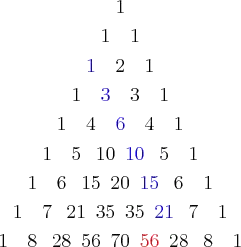
If you divide both sides by $k!$ you will get binomial coefficients and you are in fact trying to prove $$\binom kk + \binom{k+1}k + \dots + \binom{k+n-1}k = \binom{k+n}{k+1}.$$ This is precisely the identity from this question.

The same argument for $k=3$ was used here.


Or you can look at your problem the other way round: If you prove this result about finite sums $$\sum_{j=1}^n j(j+1)\dots(j+k-1)= \frac{n(n+1)\dots{n+k-1}}{k+1},$$ you also get a proof of the identity about binomial coefficients.

2

For a fixed non-negative $k$, let $$f(i)=\frac{1}{k+1}i(i+1)\ldots(i+k).$$ Then $$f(i)-f(i-1)=i(i+1)\ldots(i+k-1).$$ By telescoping,

$$\sum_{i=1}^ni(i+1)(i+2)\dots(i+k-1)=\sum_{i=1}^n\left(f(i)-f(i-1)\right)=f(n)-f(0)=f(n)$$

and we are done.

pipi
  • 2,461
1

I asked exactly this question a couple of days ago, here:

Telescoping series of form $\sum (n+1)\cdot...\cdot(n+k)$

enter image description here

My favourite solution path so far is to start with the hockey stick identity.

P i
  • 2,136
0

From (i), (ii) and (iii) it is reasonable to guess that your sum will be $$n(n+1)\cdot...\cdot(n+k)/(k+1)$$ Try to prove this by induction.

Dennis Gulko
  • 15,640