7

Points $D,E,F$ are the first trisection points of $BC,CA,AB$ respectively. Let $[ABC]$ denotes the area of triangle $ABC$. If $[ABC]=1$, find $[GHI]$, the area of the shaded triangle. (the two images are from "The Art and Craft of Problem Solving" -Paul Zeitz)

enter image description here


attempt:

Let us look at the image below first

enter image description here

We know $AF:FB = 1:2$ ,this implies $[FIA]=x \implies [FBI]=2x$. Similarly $[DIB]=2y \implies [CID] = 4y$

Because $[CAF]:[CFB]=1:2$ and $[CFB]=6y+2x$, then $[CAF]=3y+x$ and $[CIA]=3y$.

We know the ratio $AF:AB = 1:3$, so ratio $[CAF]:[CFB]=1:2$.

Why at some point we can conclude that each of the three cevians $AD, EB, CF$, are divided by the ratio $1:3:3$?

Quanto
  • 97,352
Redsbefall
  • 4,845

5 Answers5

3

You have stated in the question that $[CIA]=3y$. Thus, using this and $[CID] = 4y$ gives that $AI:ID = 3:4$. Similarly, $BG:GE = CH:HF = 3:4$.

Also, $[CAD] = [CIA] + [CID] = 3y + 4y = 7y$. In addition, using your diagram's area values, $[BAD] = x + 2x + 2y = 3x + 2y$. Since $[CAD]:[BAD] = 2:1$, we get

$$\frac{7y}{3x + 2y} = \frac{2}{1} \; \; \to \; \; 7y = 6x + 4y \; \; \to \; \; y = 2x \tag{1}\label{eq1}$$

Using $[FIA] = x$ and $[CIA]=3y$ (that you've determined) gives that $FI:IC = x:3y = x:6x = 1:6$. Also, I earlier showed $CH:HF = 3:4$, so since $1 + 6 = 3 + 4$, the base values used in both ratios are the same, and thus $FI:IH:HC = 1:3:3$.

It can be similarly proven (left to the reader) that the other $2$ cevians are divided by the same ratios.

John Omielan
  • 47,976
  • $FI:IC = x:3y$? $x$ is the area of $AIF$ – Redsbefall Sep 10 '19 at 10:27
  • @AriefAnbiya The reason that $FI:IC = x:3y$ is because $x$ is the area of $AIF$ and $3y$ is the area of $CIA$. Since they both have a common height of the line from $A$ to $CF$ which is perpendicular to $CF$, the ratio of their base line lengths is the same as the ratio of the areas. This is the same concept as used in the question text statement of "We know the ratio $AF:AB = 1:3$, so ratio $[CAF]:[CFB]=1:2$." Also, it's what I used initially to state $AI:ID = 3:4$ based on $[CIA]=3y$ and $[CID]=4y$. – John Omielan Sep 10 '19 at 15:36
  • @AriefAnbiya I've updated my answer to provide a few more details about the uses of the ratios of triangle areas matching those of the base line lengths where they have a common vertex. – John Omielan Sep 10 '19 at 15:46
2

The use of areas and ratio of areas suggest that barycentric coordinates (also named areal coordinates) could be a rather systematic way to consider this issue.

Let us show in particular (it is equivalent to the (1:3:3) proportionnality) that

$$G=\tfrac47B+\tfrac37E \ \ \ (a) \ \ \ \ \text{and} \ \ \ \ H=\tfrac17B+\tfrac67E \ \ \ (b) \tag{1}$$

Normalized barycentric coordinates of $G$ and $H$ are shown (see Edit 1 below) to be :

$$G=[\tfrac17,\tfrac47,\tfrac27] \ \text{and} \ H=[\tfrac27,\tfrac17,\tfrac47] $$

As $B = [0,1,0]$ and $E = [\tfrac13,0,\tfrac23]$, checking (a) and (b) is immediate.


Edit 1 : Barycentric equations of

$$\begin{cases}\text{Line AD} &:& b-2c&=&0& B.C. : \{0,1,-2\}\\ \text{Line BE} &:& c-2a&=&0& B.C. : \{-2,0,1\}\\ \text{Line CF} &:& a-2b&=&0& B.C. : \{1,-2,0\}\end{cases}\tag{2}$$

where $B.C.$ denote (unnormalized) barycentric coordinates of the corresponding lines.

As is well known the barycentric coordinates of the crossing point of two lines are obtained as the cross product of their B.C.

Here, for example, the barycentric coordinates of $G=AD \cap BE$ are obtained by the cross product (see (2)) :$$ \{0,1,-2\} \times \{-2,0,1\}= (1,4,2)$$

which, under its normalized form, gives $[\tfrac17,\tfrac47,\tfrac27]$ for the barycentric coordinates of $G$, as awaited.


Edit 2 : Back to areas

There is a noteworthy application of barycentric coordinates : they provide easy calculations of areas. For example, the ratio (area of triangle GHI)/(area of reference triangle ABC) is equal to the determinant :

$$\det(G,H,I)=\begin{vmatrix}\tfrac17&\tfrac27&\tfrac47\\ \tfrac47&\tfrac17&\tfrac27\\ \tfrac27&\tfrac47&\tfrac17\end{vmatrix}=\frac17.$$

Connected... and interesting : https://en.wikipedia.org/wiki/One-seventh_area_triangle

Jean Marie
  • 81,803
1

We may and do assume that the area $[ABC]$ is one.

Following the arguments of the OP, we already have the following information regarding the areas cut / separated from $[ABC]$ by two cevians, $AF$ and $BD$:

Areas delimited from a triangle by two trisectors

In particular we have $2:1=CD:DB=\color{red}{7y}:\color{blue}{3x+2y}$, which implies $7y=2(3x+2y)$, i.e. $y=2x$. Then we can immediately express the piece $x$ in terms of the total area $$ 1=[ABC]=\color{red}{7y}+\color{blue}{3x+2y}=14x+3x+4x=21x \ , $$ so $x=[AIF]=1/21$, and $y=2/21$. By the same argument, and/or by cylcic shift in the notation, we have $$ [AIF]=[BGD]=[CHE]=\frac 1{21}\ . $$ We also have so far $3y=[AIC]=6/21$. We remove the area of the triangle $\Delta CHE$ from this quantity, thus getting by symmetry the following quadrilateral areas: $$ [AIHE]=[BGIF]=[CHGD]=\frac6{21}-\frac 1{21}=\frac 5{21}\ . $$ For the triangle in the middle, the remained area is $$ [GHI]=\frac{21-1-1-1-5-5-5}{21}=\frac 3{21}=\frac 17\ . $$ In a picture:

Area of triangle delimited by three trisectors


Note: The above computed the area of the "inner" triangle $\Delta GHI$ without knowing the proportion $AI:IG:GD$. A posteriori, if we really need it, we can for instance compute $AI:ID=[CAI]:[CID]=3y:4y=3:4$, $AG:GD=[AGC]:[GDC]=6:1$.

Note: In such cases much of the effort is reduced by using directly the Theorem of Menelaus. For instance, applying it for $\Delta ABD$ with the line intersecting the sides in $F,C,I$, we can write immediately: $$ \frac{FA}{FB}\cdot\frac{CB}{CD}\cdot\frac{ID}{IA}=1\ . $$ So $AI:ID=3:4$.

dan_fulea
  • 32,856
0

enter image description here

Note that $[ACF] = [BAD] =[CBE] = \frac 13 [ABC]$ and observe that

$$[GHI] = [ABC] - \left( [ACF] + [BAD] + [CBE] \right)+ S = S$$

$S$ is the sum of the shaded (purple) areas, which is equal to the area to be evaluated. Next, we evaluate one of the shaded areas $[CEH]$. Since,

$$\frac{[CEH]}{[FEH]}= \frac{[CEB]}{[FEB]} = \frac{\frac 13 [ABC]}{\frac 23 [AEB]}= \frac{\frac 13 [ABC]}{\frac 23 \frac 23[ABC]} =\frac 34 $$

we have,

$$[CEH] = \frac{3}{7} [CEF] = \frac 37\frac 13[CAF] = \frac 37\frac 13 \frac 13[ABC] =\frac{1}{21}$$

Similarly, the other two shaded areas $[AFI] = [BDG] = \frac{1}{21}$. Therefore,

$$[GHI] = \frac{1}{21}+\frac{1}{21}+\frac{1}{21}=\frac 17$$

Quanto
  • 97,352
0

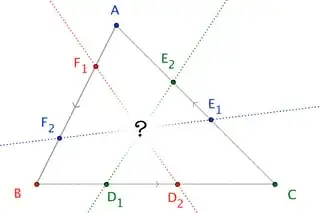
Here's an approach using the Extended Ceva's Theorem that I presented in an earlier answer way back in 2013.


Extended Ceva's Theorem. Consider points $D_1$, $D_2$, $E_1$, $E_2$, $F_1$, $F_2$ on the (extended) edges of $\triangle ABC$, with $D_i$, $E_i$, $F_i$ on the (extended) edge opposite vertex $A$, $B$, $C$, respectively.

Extended Ceva' Theorem

Lines $\overleftrightarrow{D_1E_2}$, $\overleftrightarrow{E_1F_2}$, $\overleftrightarrow{F_1D_2}$ concur if and only if $$\begin{align} 1 &= \frac{|BD_1|}{|D_1C|} \frac{|CE_1|}{|E_1A|} \frac{|AF_1|}{|F_1B|} + \frac{|D_2C|}{|BD_2|} \frac{|E_2A|}{|CE_2|} \frac{|F_2B|}{|AF_2|} \\[6pt] &+ \frac{|BD_1|}{|D_1C|} \frac{|D_2C|}{|BD_2|} + \frac{|CE_1|}{|E_1A|} \frac{|E_2A|}{|CE_2|} + \frac{|AF_1|}{|F_1B|} \frac{|F_2B|}{|AF_2|} \qquad\qquad \tag{$\star$} \end{align}$$

Note: The above uses signed lengths, with $\overrightarrow{AB}$, $\overrightarrow{BC}$, $\overrightarrow{CA}$ indicating the direction of a positively-signed segment on each of the triangle's sides.


For the problem at hand, I'll use two of the given trisecting cevians at a time, along with a line through their intersection, parallel to a side of the triangle.

First, we consider trisecting cevians $\overline{BE}$ and $\overline{CF}$ with intersection $X$, with $\overline{PQ}$ through $X$, parallel to $\overline{AB}$. To match the elements of $(\star)$, we make the following assignments:

$$D_1 = P \qquad D_2 = C \qquad E_1 = E \qquad E_2 = Q \qquad F_1 = F \qquad F_2 = B \tag{1}$$

enter image description here

Then $(\star)$ becomes

$$\begin{align} 1 &= \frac{|BP|}{|PC|} \frac{|CE|}{|EA|} \frac{|AF|}{|FB|} + \frac{|CC|}{|BC|} \frac{|QA|}{|CQ|} \frac{|BB|}{|AB|} + \frac{|BP|}{|PC|} \frac{|CC|}{|BC|} + \frac{|CE|}{|EA|} \frac{|QA|}{|CQ|} + \frac{|AF|}{|FB|} \frac{|BB|}{|AB|} \tag{2} \\[6pt] &= \frac{|BP|}{|PC|}\cdot \frac12\cdot \frac12 + 0 + 0 + \frac12 \cdot \frac{|QA|}{|CQ|} + 0 \tag{3} \end{align}$$

Now, defining $$\lambda := \frac{|CX|}{|XF|} = \frac{|CP|}{|PB|} = \frac{|CQ|}{|QA|} \tag{4}$$ we have $$1 = \frac1{\lambda} \cdot \frac14 + \frac12 \cdot \frac1{\lambda} \quad\to\quad \lambda = \frac34 \tag{5}$$


On the other hand, we can take $\overline{RS}$ through $X$, parallel to $\overline{AC}$. We make new assignments with respect to $(\star)$:

$$D_1 = B \qquad D_2 = R \qquad E_1 = C \qquad E_2 = E \qquad F_1 = S \qquad F_2 = F \tag{6}$$

enter image description here

This time, $(\star)$ becomes

$$\begin{align} 1 &= \frac{|BB|}{|BC|} \frac{|CC|}{|CA|} \frac{|AS|}{|SB|} + \frac{|RC|}{|BR|} \frac{|EA|}{|CE|} \frac{|FB|}{|AF|} + \frac{|BB|}{|BC|} \frac{|RC|}{|BR|} + \frac{|CC|}{|CA|} \frac{|EA|}{|CE|} + \frac{|AS|}{|SB|} \frac{|FB|}{|AF|} \tag{7} \\[6pt] &= 0 + \frac{|RC|}{|BR|} \cdot 2 \cdot 2 + 0 + 0 + \frac{|AS|}{|SB|} \cdot 2 \tag{8} \end{align}$$

Defining $$\mu := \frac{|BX|}{|XE|} = \frac{|BR|}{|RC|} = \frac{|BS|}{|SA|} \tag{9}$$ we have ... $$ 1 = \frac1{\mu} \cdot 4 + \frac1{\mu} \cdot 2 \qquad\to\qquad \mu = 6 \tag{10}$$


The result follows from $(5)$ and $(10)$, as well as the symmetry in how the ratios apply across all of the cevians. $\square$

Blue
  • 75,673