4

How would I find the derivative of a unit step function? I understand that the unit impulse function will be used but I'm not sure how to use it.

I am trying to find the derivative of this:

$v(t) = u(t+1) - 2u(t) + u(t-1)$

$u(t) = 0$ when $t < 0$

$u(t) = 1$ when $t > 0$

The relationship between unit step function and impulse function:

δ(n) = u(n) - u(n-1)

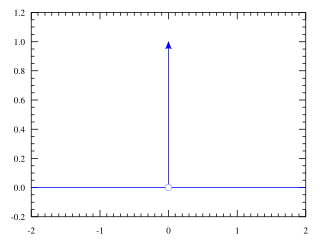
$ δ(t)=du(t)/dt $

zdub
  • 66

1 Answers1

3

The derivative of unit step $u(t)$ is Dirac delta function $\delta(t)$, since an alternative definition of the unit step is using integration of $\delta(t)$ here.

$$u(t) = \int_{-\infty}^{t} \delta(\tau) d\tau$$

Hence, $$\frac{dv}{dt} = \delta(t+1) - 2\delta(t) + \delta(t-1)$$

Crypton
  • 108
msm
  • 7,147
  • Thanks! So the graph of the derivative would just be vertical lines at t = -1, 0 and 1? – zdub Nov 01 '16 at 00:21
  • @zdub The way that engineers draw it, there should be vertical arrows at $1$ and $0$, each of which is $2$ units tall (but at $0$ it should point in the opposite direction). –  Nov 01 '16 at 00:24
  • @zdub You have two $u(t-1)$ in your question, or $2u(t-1)$. This means the derivative is a $2\delta(t-1)$ that is represented by an upward arrow with amplitude $2$ at $t=+1$. If your actual question is $u(t-1)+2u(t)+u(t+1)$, then there will be three upward delta functions in the derivative: two of them are at $t=\pm1$ with unit scale, and the third at origin with scale $2$. – msm Nov 01 '16 at 00:33
  • 1
    Just to clarify: Dirac delta is NOT a function. See https://math.stackexchange.com/questions/285642/is-the-dirac-delta-function-really-a-function – A. J. Pan-Collantes Oct 16 '22 at 06:07