To add to lab's response, a useful trick is to draw a picture of the real line. On it, indicate the critical points at which your absolute value functions switch signs. (In this case, those points are $-\frac{1}{3}$ and $3.5$.) Now, consider the various cases where $x$ may be located on that real line.
For example, for $x\geq 3.5$ (i.e. $x$ lies on or to the right of the point $3.5$), then $|3x+1|=3x+1$ and $|2x-7|=2x-7$ so you have
$$
3x+1>2x-7\implies x>-8
$$
which is already satisfied for all $x\geq 3.5$. So $x\geq 3.5$ works. Now you move on to the next case (e.g. $-\frac{1}{3}\leq x<3.5$).
EDIT: fine, a bit more details: now that we have established $x\geq 3.5$ works, consider $-\frac{1}{3}\leq x<3.5$. In this case, $|3x+1|=3x+1$ and $|2x-7|=7-2x$ so
$$
3x+1>7-2x\implies 5x>6\implies x>\frac{6}{5}.
$$
So if $-\frac{1}{3}\leq x<3.5$, you want $x>\frac{6}{5}$. In other words, $x\in(\frac{6}{5},3.5)$ works.
Finally, consider $x<-\frac{1}{3}$. Then, $|3x+1|=-3x-1$ and $|2x-7|=7-2x$ so
$$
-3x-1>7-2x\implies x<-8.
$$
So you want $x\in(-\infty,-\frac{1}{3})\cap(-\infty,-8)=(-\infty,-8)$.
Putting all cases together, the solution set is
$$
(-\infty,-8)\cup(\frac{6}{5},3.5)\cup[3.5,\infty)=(-\infty,-8)\cup(\frac{6}{5},\infty).
$$
All this is a lot easier if you have a picture while following it.
EDIT 2: another visual aid for simple cases like this is to plot both the left hand side and right hand side. This is another way to make sure you understand how the absolute value function works. You should get something like this:
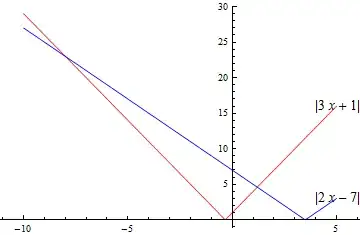
Now, you are interested in the values of $x$ where the red line is above the blue line.


