From Set Theory and Linear Algebra, we have these two theorems:
- Given two finite sets of the same cardinality $X$ and $Y$ and a function $f:X\rightarrow Y$, the following are equivalent:
- $f$ is a bijection
- $f$ is an injection
- $f$ is a surjection
- Given two finite dimensional vector spaces of the same dimension $V$ and $W$ and a linear map $T:V\rightarrow W$, the following are equivalent:
- $f$ is an isomorphism
- $f$ is a monomorphism
- $f$ is an epimorphism
The parallel nature of these theorems suggests they are related. And I have an inkling that Category Theory can make the relationship explicit.
Functors preserves isomorphisms in general, so if I can find a combination of functors which preserve epimorphisms and monomorphisms in a convenient way, we can actually show that the first theorem implies the second.
I know there is an adjoint pair $G\dashv F$ where $F$ is the forgetful functor from Vect $_K$ to Set and $G$ is the functor which sends a set to the free vector space generated by it. And I also know that both $F$ and $G$ are faithful (but not in general full).
But I am having difficulty in getting these facts to work together nicely. Any help in making my ideas rigorous, or an explanation why I'm barking up the wrong tree, is appreciated.
EDIT
If we considered the free v.s. functor from FinSet to FinVect $_K$, we will then have a faithful functor. Since faithful functors reflect monomorphisms and epimorphisms, if we can find a parallel mono (or epic) map that is in the range of the free v.s. functor for every mono (or epic) map we encounter, we'd be able to show the 1st theorem implies the 2nd. Using the fact that vector spaces of the same dimension are isomorphic, we can conclude that the free v.s. functor is also dense. Hence if $V$ and $W$ are vector spaces of the same dimension, and $m:V\hookrightarrow W$ we'd be done if we can find an $f:X\rightarrow Y$ which makes the following diagram commute:
$\hskip2in$ 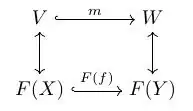
I'm sure a clever choice of bases on $V$ and $W$ and subsequent choices for the isomorphisms would make this possible, but these choices essentially use the 2nd theorem. And this approach doesn't seem to port over to epimorphisms.
