5

Courtesy of this xkcd comic I now know that

$$ \sum_{n=1}^\infty \frac{1}{n^n} \approx \ln^e(3) $$

Echoing the views of the comic itself, if I ever find myself taking $\ln^e(x)$ then something has gone horribly horribly wrong. What exactly is it that is going on here then?

I tried attempting a proper solution but it seems beyond me. Here's a wolfram link confirming that this equation is actually valid.

I'm not sure, but maybe this can be approximated by a Riemann sum, followed by evaluating that through integration? As of now I am just tagging it as summation, recreational-mathematics, and approximation. After a solution is posted I will edit in tags to reflect how it was solved.

Guy
  • 8,857
  • 1
  • 28
  • 57

2 Answers2

4

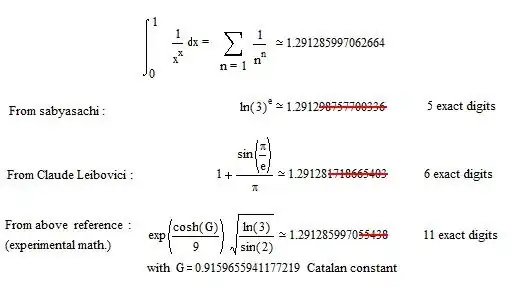
By the way, $$ \sum_{n=1}^\infty \frac{1}{n^n} \approx 1+\frac{\sin \left(\frac{\pi }{e}\right)}{\pi } $$ seems to be a better approximation.

According to RIES, $$\sum_{n=1}^\infty \frac{1}{n^n} \approx\left(\frac{\phi +\pi }{2}\right)^{\frac{1}{\pi+\frac{1}{4} }}$$ is still better but not as good as the one proposed by JJacquelin.

Next one, please !

  • 1
    Hi Claude Leibovici ! Why did you delete your interesting answer about series approximation ? I would have voted to approve it. – JJacquelin Mar 08 '14 at 10:00
  • 1
    I felt later it was stupid. Just compute the first terms of the series and add them up. I must say that I was happy to find that but later realized that it was of very marginal interest. If you think it brings something, let me know and I shall put it back. – Claude Leibovici Mar 08 '14 at 10:04
  • 1
    I think that the methods of approximation with limited series cannot be forgotten and must be cited when a matematical problem of this kind is posed. Your anwer was an example. I was pleased to see that this kind of method has been successfully applied. Cheers. – JJacquelin Mar 08 '14 at 10:14
  • Of couse, the interest of the series is purely theoritical. That is the important point. On the other hand, of course, there is no practical interest since the first terms of the series $\sum_{n=1}^\infty \frac{1}{n^n}$ are simpler and give an approximation as accurate as we want. – JJacquelin Mar 08 '14 at 10:26
  • @JJacquelin.I went to your book and I have been extremely interested. Is your method available either as a standalone program or a CAS application ? Thanks. – Claude Leibovici Mar 09 '14 at 08:08
  • @ Claude Leibovici : My own soft is home made and is not available on a standard form. The paper referenced above gives the hints to anybody who want to write by himself such a program. But it is a very simplified version compared to much more elaborated programs made a long time ago by specialists. For example, the so called "Inverseur" by Simon Plouffe (at universities of Montréal, Canada and Bordeaux, France : http://pi.lacim.uqam.ca/fra/ but it seems out of service today) Also, see : http://isc.carma.newcastle.edu.au/ – JJacquelin Mar 09 '14 at 08:46
  • @ClaudeLeibovici what method is exactly discussed here in comments? Is it still "deleted"? Sounds like something interesting! – Kusavil Jan 25 '23 at 19:02
  • 1
    @Kusavil. I was using the integral equivalent with a series expansion of the integrand around $x=0$. – Claude Leibovici Jan 26 '23 at 04:10
2

Very accurate approximations can be computed thanks to series expansions such as the example given by Claude Leibovici (13 exact digits in case of $S(10)$)

Other methods of numerical calculs leads to a lot of numerical appoximations of various kind. Some examples are compared below.

Many surprising formulas are very easily obtained with the method of experimental calculus described in the paper "Mathématiques expérimentales" pubished on Scribd : http://www.scribd.com/JJacquelin/documents (in French, not translated yet)

enter image description here

JJacquelin
  • 66,221
  • 3
  • 37
  • 87