1

In Mathographics Robert Dixon shows how to draw an Egg-curve (or really half of an egg curve) as an involute:

enter image description here

This allows you to draw a smoother version of eggs created from the 'arcs of a circle method.'

I want to know the formula for idealized involute curves of this type (i.e., 0-D pins, and 0 width string, etc....):

What is the formula for parametric equations for points, $(x_1, y_1), (x_2, y_2), (x_3, y_3)..., (x_n, y_n)$, given a starting point $(x_f, y_f)$ and a point $(x_O, y_O)$ where the string is attached?

Blue
  • 75,673
Johnny
  • 11
  • 2
  • 1
    @Moo Thank you. I've read that paper. So far as I can tell, it gives good instructions for the geometric constructions made with circle arcs (which I view as approximations of the involute, like a 'spiral' made from circle arcs can approximate a logarithmic spiral).

    What I'm looking for are the parametric equations of the 'string, pins, and pen' involute given by Dixon (see image attached in post).

    – Johnny Mar 25 '24 at 23:36

1 Answers1

0

Have a look at Fig. 1 modelizing the position of the extremity of a string rolled/unrolled along a convex polygon (here the particular case of a regular octagon) generating a kind of spiral (modelizing rather well a half-egg-shape) ?
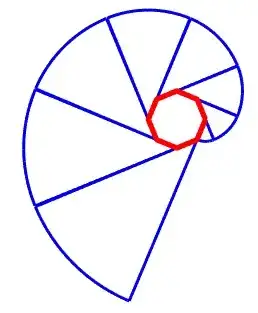
enter image description here

Fig. 1.

But one can obtain much general type of curves as one can see on Fig. 2 (see Matlab program below). Here, four different curves ("offsets" of the first one) are displayed just by changing the curve length.

enter image description here

Fig. 2.

Last but not least, being a Frenchman, I don't resist the pleasure to offer you a "croissant" (with eggs entering into its composition :)) :
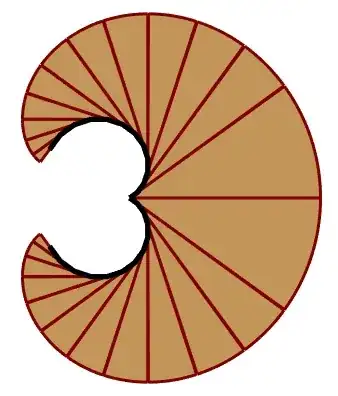
enter image description here

Fig. 3.

Matlab program (using complex numbers geometry) having generated figure 2 :

 function main;
    a=80;axis([-a,a,-a,a])
    A=[0,pi/4,pi/3,pi/2,2*pi/3,pi,5*pi/4,3*pi/2,7*pi/4,2*pi];% sides polar angles
    Lg=[1,1,3,2,7,1,4,5,20,20];% side lengths
    V=Lg.*exp(A*i);A=[A,A(1)];Lg=[Lg,Lg(1)];L=sum(Lg);
    LA=length(A);
    Pt=cumsum(V);% points, obtained by cumulating vectors
    for k=0:2:6
       C=[]; % curve
       M=L+k;
       for k=1:LA-2
          T=cs(Pt(k),M,A(k),A(k+1));
          C=[C,NaN,T];
          M=M-Lg(k+1);
       end;
       plot(C,'b','linewidth',2);hold on;
    end;
    plot(Pt,'color','r','linewidth',4);hold on
    %%%
 function T=cs(ce,r,t1,t2);% circular sector
    s=sign(t2-t1);
    T=ce+r*[0,exp(i*(t1:s*0.005:t2)),0];
Jean Marie
  • 81,803
  • But you see that I haven't attempted to provide any equation... – Jean Marie Mar 26 '24 at 14:50
  • Thank you for the answer. I can derive equations for involutes of the kind you showed (albeit a complicated thing with modulus and a bunch of trig functions). The issue I'm having is with the way the Dixon curve unwraps and then wraps back again. It's as though the curve is the involute of two evolutes. I've hit a wall trying to calculate that. If there's some regular polygon that can generate the same curve as an involutes then I could certainly come up with the equations. – Johnny Mar 26 '24 at 16:08
  • **Edit: regular or irregular polygon

    Also, I would think that any involute of the sort shown will be a very close approximation of some other curve, e.g., a logarithmic spiral, generally with much easier equations.

    – Johnny Mar 26 '24 at 16:31
  • Yes, I think that the possibilities offered by this way of connecting arcs of circles has its own limits. I have been working on them for the design of constant diameter convex curves (called "wheels" : see my detailed answer here). Besides, see the third drawing I just added. – Jean Marie Mar 26 '24 at 18:23
  • About the curve in Fig. 1 : which is very similar to an involute of a circle see here with connection with gears. – Jean Marie Mar 26 '24 at 18:34