2

In my integration adventures, I ran into this sum:

$$\sum_{n=1}^{\infty}\frac{1}{\cosh(\pi an)(4n^{2}-1)}$$

I know that $\sum_{n=1}^\infty \frac{1}{\cosh(\pi n)}$ has a nice closed form, so I was wondering if this sum does as well.

If no closed form exists (or it's hard to find) for all $a$, I would be interested in evalutating the sum when $a$ is given a set (but nonzero) value, like $a=1$ or $a=\frac 1 \pi$.

Argon
  • 25,303
  • I don't have the luxury of pencil and paper at the moment, but given the symmetry of the summand, you may be able to evaluate it using contour integration against the function $\pi \cot (\pi z)$. Assuming you haven't solved it yet that is. – TeeJay Sep 08 '16 at 00:58

2 Answers2

1

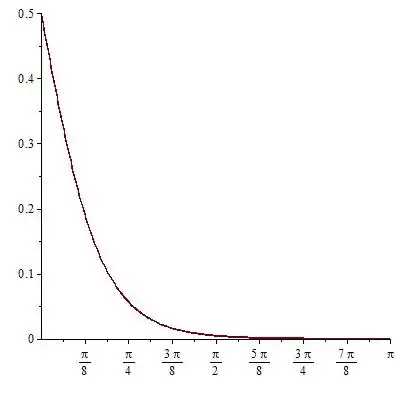
Maple easily evaluates the sum under consideration: $$S:= a\mapsto \sum _{n=1}^{\infty }{\frac {1}{\cosh \left( \pi \,an \right) \left( 4\,{n}^{2}-1 \right) }}, $$ $$evalf(S(1))=0.029009296189396298541.$$ $$plot(S,0..Pi)$$ enter image description here

user64494
  • 5,811
1

As long as $|e^{a \pi}|<1$, you can rewrite $\cosh (a \pi n)=\frac{e^{a \pi n}+e^{-a \pi n}}{2}$, so your denominator becomes $\frac{e^{a \pi n}}{2}<(e^{a \pi n}+e^{-a \pi n})(4n^2-1)<2e^{a \pi n}$, hence your infinite sum is upper-bounded by $$ \sum_{k=0}^{\infty}e^{-a \pi k} < S<4 \sum_{k=0}^{\infty}e^{-a \pi k} $$ which converges and should give you good upper and lower bounds

Alex
  • 19,262