2

The first derivative test says that if the derivative of a function is positive/negative in the open interval $(x-a,x)$ and negative/positive in the open interval $(x,x+b)$ where both $a$ and $b$ are greater than zero, then there is a local maxima/minima at $x$. Is the reverse of this statement true ?

For example, if $x$ is a local maxima of the function $f(x)$ and if the function $f(x)$ is continuous and differentiable in $(a,b)$ where $a < x < b$, then there exists an interval to the left of $x$, howsoever small, in which the function has a positive slope and an interval to the right of $x$, howsoever small, in which the function has a negative slope.

Menezio
  • 3,220
  • 1
    By “reverse” I think you mean converse. And I think the answer to your question is “yes”. To see why- look at the definition of “(local) maximum”. – Adam Rubinson Apr 11 '20 at 16:09
  • Also, I think your phrase, “howsoever small”, is redundant in your question. – Adam Rubinson Apr 11 '20 at 17:11
  • I agree that the phrase "howsover small" is redundant. As an afterthought, I think I should have mentioned in the converse statement that x needs to be a strict local maxima/minima since the first derivative test is a criteria for a strict local maxima or minima. Would you agree ? – Tirthankar Apr 11 '20 at 17:47
  • I don’t think that distinction matters very much. The hard part in trying to prove your question is in considering points with strictly negative derivative as you approach x from below. – Adam Rubinson Apr 11 '20 at 18:03
  • I think that you don't mean any interval to the left of $x,$ but rather one that ends at $x,$ and you don't mean any interval to the right of $x,$ but rather one that begins at $x.$ – md2perpe Apr 11 '20 at 22:31
  • That is correct. I did mean intervals ending and beginning at x. – Tirthankar Apr 12 '20 at 05:00

1 Answers1

6

TL;DR: The answer is no, and I provide a counterexample. See md2perpe’s comment on this answer for more details.

Consider the function:

$f(x) = x^2(\sin(1/x)-1.5)$ for $x \neq 0$ and $f(0) = 0.$

This is what the graph looks like (from WolframAlpha)
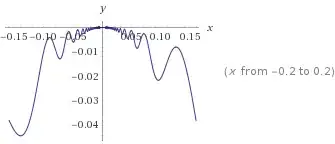
graph of <span class=$f(x) = x^2(\sin(1/x)-1.5)$ ">

$$$$ Then:

$f(x) < 0 $ for all $ x \neq 0$ because $ x^2 > 0 \ \forall x \neq 0 $ and $\sin(1/x)-1.5 < 0 \ \forall x \neq 0$. Hence the origin is a local (in fact, global) maximum.

Using the same method as the main answer to this question, we see that $f’(0) = 0.$

Furthermore, for $x \neq 0,\ f’(x) = 2x(\sin(1/x) - 1.5) - \cos(1/x),\ $ which is defined for all values $x \neq 0.$

Therefore $f’(x)$ is differentiable for all x in some interval containing the maximum (the origin). (In fact, we see that $f(x)$ is differentiable for all x).

However, we just found what the derivative of $f(x)$ is for $x \neq 0$: $f’(x) = 2x(\sin(1/x) - 1.5) - \cos(1/x)$, which, as $x {\to} 0,\ $ tends to $-\cos(1/x)$, and so oscillates between approximately -1 and 1 (as $x {\to} 0$).

If you want to know where my idea for this came from, I am somewhat familiar with the graph of $g(x) = x^2\sin(1/x)\ $ for $ x \neq 0 $ and $f(0) = 0.$

I considered “pushing the points” (other than the origin) downwards to just below $y=0$. I noted that $x^2\sin(1/x)$ just touches the graph of $ y=x^2$ at various points (as $x {\to} 0$), so I first considered $x^2\sin(1/x) - x^2,\ $ which, by the way, is the same as $x^2(\sin(1/x) - 1),\ $ and this would have been sufficient if the question didn’t require strict maximum. So for a strict maximum, I tried 1.5 instead of 1 and voila!.

Adam Rubinson
  • 20,052
  • 1
    TL;DR: This function is a counterexample. It has a local (even global) maximum at $x=0$ but there is no interval $(-a, 0)$ on which $f'(x)>0,$ and no interval $(0,b)$ on which $f'(x)<0.$ – md2perpe Apr 11 '20 at 22:29
  • Yes I have added that in at the beginning – Adam Rubinson Apr 11 '20 at 22:31
  • Thanks a lot for providing the counterexample. – Tirthankar Apr 12 '20 at 07:21
  • You’re welcome. Seeing as you’re new to the site, I’ll inform you: you can accept an answer to your own question if you feel like it answers your question. You can do this by clicking the green tick at the top of the answer. But you can only accept one answer to a question. You also gain points for accepting an answer to your question. Just saying... – Adam Rubinson Apr 12 '20 at 12:46