As the answers to this question (I think) successfully argue, it is often more useful to consider manifolds as intrinsically, i.e. without reference to an ambient Euclidean space. I am wondering if I have found a simple example of this phenomenon.
Consider the torus trefoil knot: 

It can be embedded into $\mathbb{R}^3$, as the above pictures hopefully illustrate. What is perhaps surprising, however, is that it is in fact homeomorphic to the regular torus in $\mathbb{R}^3$ (I think).
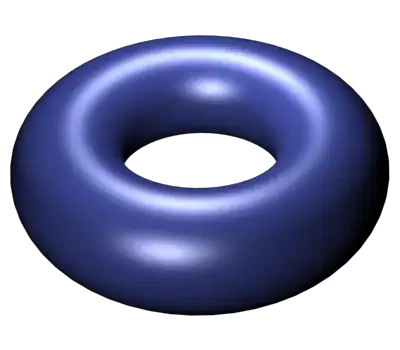
Question: Is it impossible to "unknot" the trefoil torus into a regular torus without leaving $\mathbb{R}^3$? I.e. does any homeomorphism between the two "factor through a higher dimensional space"?
Does this impossibility (if it is true) show the need for abstract manifolds? I.e. is this a concrete example where ambient spaces actually make things more confusing, rather than less?
The only homeomorphisms I can think of which "take place in $\mathbb{R}^3$" involve self-intersections, which, being "unphysical", I think implies factoring through a higher dimensional space. The same might be true for cutting the knot, "untying it", and then reattaching it at the same two places it was cut.


