10

The Problem

I am trying to show that $ \displaystyle \int^{\infty}_{0} \frac{\ln (1+x)}{x(x^2+1)} \ dx = \frac{5{\pi}^2}{48}$

My attempt

I've tried substituting $x=\tan\theta$, and then using the substitution $u=1 + \tan \theta $ which gives:

$ \displaystyle \int^{\infty}_{1} \frac{\ln u}{(u-1)(u^2-2u+2)} \ du $ , however I am unable to evaluate this.

Sigma
  • 603

6 Answers6

7

I know the OP said "without complex analysis," but I am going to offer a way to do this integral using the Residue Theorem anyway because it is nice to see the power of complex methods with these integrals.

The analysis will mirror that computed in this answer for a more complicated case. We begin by considering the following contour integral:

$$\oint_C dz \frac{\log{(1+z)} \log{z}}{z (1+z^2)} $$

where $C$ is a keyhole contour of outer radius $R$ and inner radius $\epsilon$ as defined in the figure below:
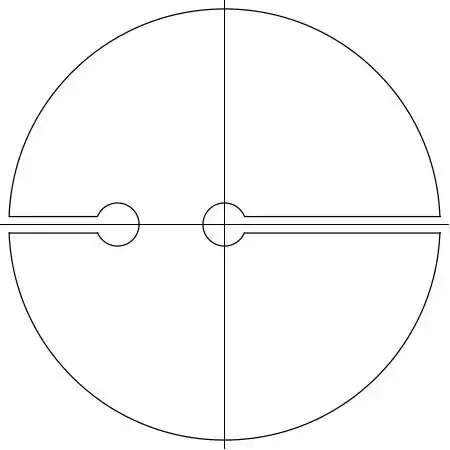
enter image description here

That is, $C$ avoids the branch points at $z=0$ and $z=-1$. As demonstrated in the linked-to answer, each logarithm provides a jump of $-i 2 \pi$ across their respective branch cut. (The reason is due to the clockwise traversal around the branch point as the contour is traversed in the positive sense.) Because the integral over the arcs vanish as $R \to \infty$ and $\epsilon \to 0$, the contour integral is equal to

$$-i 2 \pi \int_0^{\infty} dx \frac{\log{(1+x)}}{x (1+x^2)} - i 2 \pi \int_{e^{i \pi}}^{\infty \, e^{i \pi}} dt \frac{\log{t}}{t (1+t^2)}$$

Note that the branch cut for $\log{z}$ is $[0,\infty]$ and, for the arguments $z$ fed into $\log{z}$, $\operatorname{arg}{z} \in [0,2 \pi)$. Also, the branch cut for $\log{(1+z)}$ is $(-\infty,-1]$ and, for the arguments $z$ fed into $\log{(1+z)}$, $\operatorname{arg}{z} \in (-\pi,\pi]$.

The second integral is evaluated using $t=u e^{i \pi}$, and is equal to

$$\begin{align}\int_1^{\infty} du \frac{i \pi +\log{u}}{u (1+u^2)} &= i \pi \int_1^{\infty} du \frac{1}{u (1+u^2)} + \int_1^{\infty} du \frac{\log{u}}{u (1+u^2)} \\ &= i \pi \int_0^1 du \frac{u}{1+u^2} - \int_0^1 du \frac{u \log{u}}{1+u^2}\\ &= i \frac{\pi}{2} \log{2} - \left [ \frac{d}{d\alpha}\sum_{k=0}^{\infty} (-1)^k \int_0^1 du \, u^{2 k +1+\alpha} \right ]_{\alpha=0} \\ &= i \frac{\pi}{2} \log{2} + \frac14 \sum_{k=0}^{\infty} \frac{(-1)^k}{(k+1)^2} \\ &= i \frac{\pi}{2} \log{2} + \frac{\pi^2}{48} \end{align}$$

The contour integral is also equal to $i 2 \pi$ times the sum of the residues at the poles $z_1=e^{i \pi/2}$ and $z_2=e^{i 3 \pi/2}$. This sum is equal to

$$\begin{align}\sum_{k=1}^2 \operatorname*{Res}_{z=z_k} \frac{\log{(1+z)} \log{z}}{z (1+z^2)} &= \frac{\log{(1+i)} \log{\left ( e^{i \pi/2}\right )}}{i (2 i)} + \frac{\log{(1-i)} \log{\left ( e^{i 3 \pi/2}\right )}}{(-i) (-2 i)}\\&= -\frac12 \left [\log{\left (\sqrt{2} e^{i \pi/4} \right )} i \frac{\pi}{2} + \log{\left (\sqrt{2} e^{-i \pi/4} \right )} i \frac{3\pi}{2} \right ]\\ &= -i \frac{\pi}{2} \log{2} - \frac{\pi^2}{8} \end{align}$$

Therefore, we may find the desired integral from

$$\int_0^{\infty} dx \frac{\log{(1+x)}}{x (1+x^2)} + i \frac{\pi}{2} \log{2} + \frac{\pi^2}{48} = i \frac{\pi}{2} \log{2} + \frac{\pi^2}{8} $$

or

$$\int_0^{\infty} dx \frac{\log{(1+x)}}{x (1+x^2)} = \frac{5 \pi^2}{48} $$

as was to be shown.

Ron Gordon
  • 138,521
6

First, divide the integral into two parts: $$I=\int_0^\infty \frac{\ln(1+x)}{x(1+x^2)}dx=\int_0^1+\int_1^\infty=I_1+I_2.$$ In the second one we can change the variable to $t=1/x$: $$I_2=\int_1^\infty\frac{\ln(1+x)}{x(1+x^2)}dx=\int_0^1\frac{t\ln(1+\frac{1}{t})}{1+t^2}dt=\int_0^1\frac{t\ln(1+t)}{1+t^2}dt-\int_0^1\frac{t\ln t}{1+t^2}dt.$$ Therefore, $$I=\int_0^1 \frac{\ln(1+x)}{x(1+x^2)}dx+\int_0^1\frac{t\ln(1+t)}{1+t^2}dt-\int_0^1\frac{t\ln t}{1+t^2}dt=$$ $$=\int_0^1\left(t+\frac{1}{t}\right)\frac{\ln(1+t)}{1+t^2}dt-\int_0^1\frac{t\ln t}{1+t^2}dt=\int_0^1\frac{\ln(1+t)}{t}dt-\frac14\int_0^1\frac{\ln t}{1+t}dt.$$ Integrating by parts yields $$\int_0^1\frac{\ln t}{1+t}dt=\ln t\ln(1+t)\Biggl|_0^1-\int_0^1\frac{\ln(1+t)}{t}dt=-\int_0^1\frac{\ln(1+t)}{t}dt,$$ so $$I=\frac54\int_0^1\frac{\ln(1+t)}{t}dt=\frac54\int_0^1\sum_{n=1}^\infty(-1)^{n-1}\frac{x^{n-1}}{n}dt=\frac54\sum_{n=1}^\infty\frac{(-1)^{n-1}}{n^2}=\frac54\frac{\pi^2}{12}=\frac{5\pi^2}{48}.$$

CuriousGuest
  • 4,291
  • 1
  • 19
  • 33
5

We have: $$I=\int_{0}^{+\infty}\frac{\log(u+1)}{u^3+u}\,du =\int_{0}^{+\infty}\int_{0}^{1}\frac{1}{(u^2+1)(1+uv)}\,dv\,du$$ and by exchanging the order of integration, then setting $v=\sqrt{w}$: $$ I = \int_{0}^{1}\frac{\pi +2v\log v}{2+2v^2}\,dv =\frac{\pi^2}{8}+\int_{0}^{1}\frac{v\log v}{1+v^2}\,dv=\frac{\pi^2}{8}+\frac{1}{4}\int_{0}^{1}\frac{\log w}{1+w}\,dw$$ so: $$ I = \frac{\pi^2}{8}-\frac{\pi^2}{48} = \color{red}{\frac{5\pi^2}{48}}. $$

Jack D'Aurizio
  • 353,855
3

Here is a step-by-step approach: let $I$ denote the integral to be computed.

  • Split $I$ into an integral on $(0,1)$ and an integral on $(1,+\infty)$.
  • Deduce from this decomposition that $I=J+K$ where $$J=\int_0^1\frac{\log(1+x)}x\mathrm dx,\qquad K=\int_0^1\frac{-x\log(x)}{1+x^2}\mathrm dx.$$
  • Integrate $K$ by parts, using the functions $u=\log(1+x^2)$ and $v=-\log x$, thus $$K=\frac12L,\qquad L=\int_0^1\frac{\log(1+x^2)}x\mathrm dx.$$
  • Use the change of variable $x\to x^2$ in $L$ to deduce that $$L=\frac12J.$$
  • Expand $\log(1+x)$ as an alternated series $$\log(1+x)=\sum_{n\geqslant1}(-1)^{n-1}\frac{x^n}n,$$ to deduce that $$J=\sum_{n\geqslant1}(-1)^{n-1}\left.\frac{x^n}{n^2}\right|_0^1=S,\qquad S=\sum_{n\geqslant1}\frac{(-1)^{n-1}}{n^2}.$$
  • Note that $$S=\sum_{n\geqslant1}\frac{1}{n^2}-\sum_{n\geqslant1}\frac{2}{(2n)^2}=\frac12\zeta(2).$$
  • Deduce from all this that $$I=\frac54J=\frac58\zeta(2).$$
  • Conclude with $$\zeta(2)=\frac{\pi^2}6.$$
Did
  • 279,727
1

Feynman’s Integration Technique

Let $$ I(a)=\int_0^{\infty} \frac{\ln (1+a x)}{x\left(x^2+1\right)} d x $$ Then $$ \begin{aligned} I^{\prime}(a) & =\int_0^{\infty} \frac{1}{\left(x^2+1\right)(1+a x)} d x \\ & =\frac{1}{a^2+1} \int_0^{\infty}\left(\frac{a^2}{1+a x}+\frac{1-a x}{x^2+1}\right) d x\\&= \frac{1}{a^2+1}\left(a \ln a+\frac{\pi}{2}\right) \end{aligned} $$ Integrating back yields \begin{aligned} I(1)-I(0)&=\int_0^1\left(\frac{a\ln a}{a^2+1}+\frac{\pi}{2\left(a^2+1\right)}\right) d a \\I=I(1)&= -\frac{\pi^2}{48}+\frac{\pi^2}{8}=\frac{5 \pi^2}{48} \quad ( \textrm{Details refers to Footnote.}) \end{aligned}


Footnote: $$ \begin{aligned} \int_0^1 \frac{a \ln a}{a^2+1} d x = & \sum_{n=0}^{\infty}(-1)^n \int_0^1 a^{2 n+1} \ln a d a\\ = & \sum_{n=0}^{\infty}(-1)^n\left(-\frac{1}{4(n+1)^2}\right) \\ = & -\frac{1}{4}\left[\sum_{n=1}^{\infty} \frac{1}{n^2}-2 \sum_{n=1}^{\infty} \frac{1}{(2 n)^2}\right] \\ = & -\frac{1}{4} \cdot \frac{1}{2} \sum_{n=1}^{\infty} \frac{1}{n^2} \\ = & -\frac{\pi^2}{48} \end{aligned} $$

Lai
  • 20,421
0

Hint, Note that:

$$\displaystyle \int^{\infty}_{1} \frac{\ln u}{(u-1)(u^2-2u+2)} \ du=\displaystyle \int^{\infty}_{1} \frac{u\ln u}{u(u-1)(u^2-2u+2)} \ du$$

Now take $w=\ln u$, and apply partial fractions.